Justine Emard: “AI is too often reduced to a simple tool”
The complex links that humans weave with machines hold almost no secrets for Justine Emard. The French artist has been exploring this world for many years. Pushing the boundaries of art, she creates, from her own computer models, a sensitive work, rehabilitating artificial intelligence.
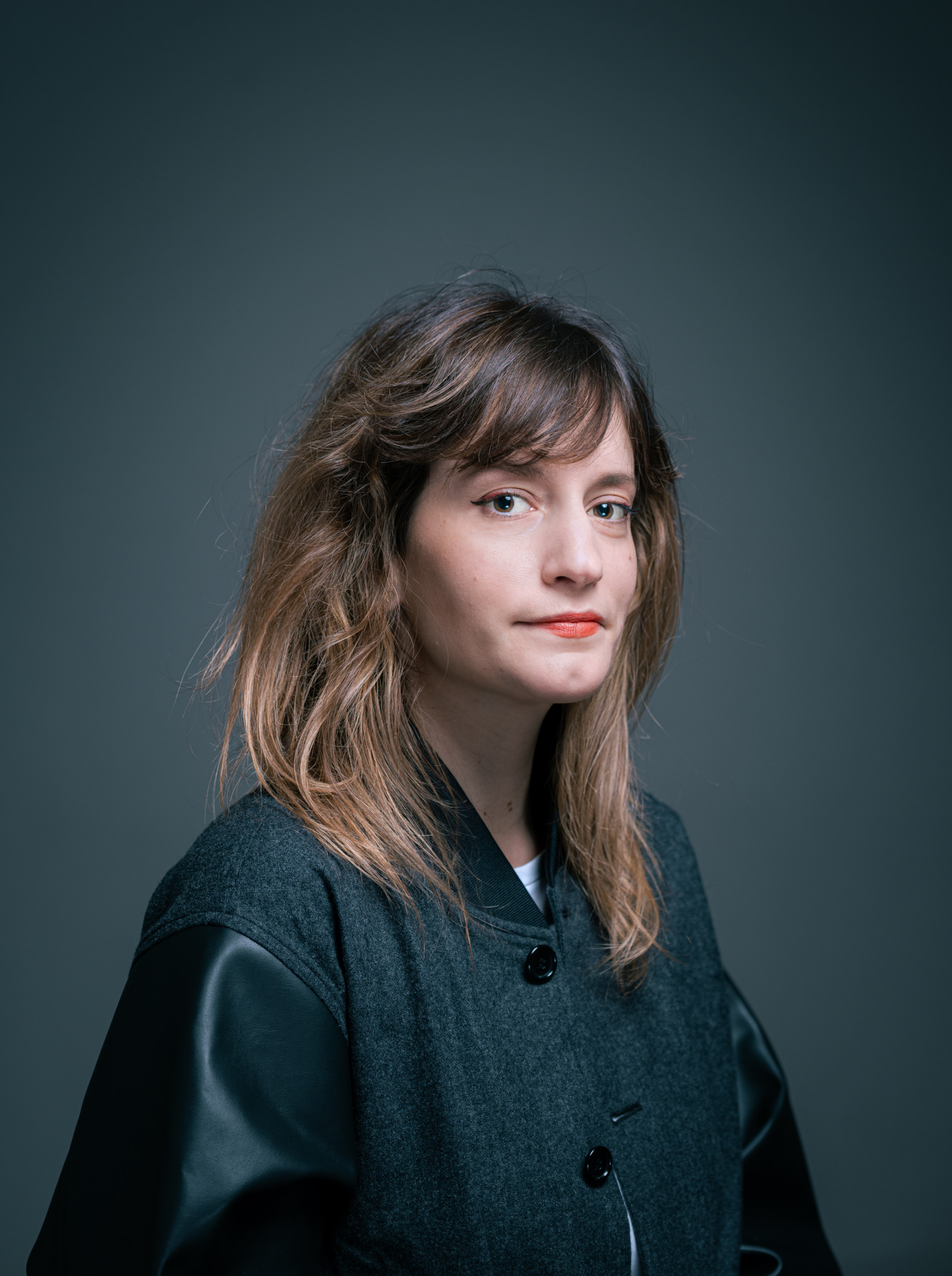
Justine Emard - Photo credit: Quentin Chevrier
A leading figure in the field of contemporary art and technology, French artist Justine Emard exhibits her work worldwide. Her installations explore and create novel relationships between organic life and AI , pushing boundaries and envisioning new perspectives on coexistence in our world. Appointed artistic director of the French pavilion at the upcoming Osaka World Expo (starting in April 2025), Justine spoke at We Are French Touch 2024. We met with her there.
French Touch: We know you wear many hats, from artistic director to professor, you also write in research journals… How did art first become the focus of this interdisciplinary journey?
Justine Emard: I never really questioned whether I wanted to be an artist; it just came to me. I always wanted to create, to invent, and that's what naturally led me to art studies. But those studies were too narrow for me, because I wanted to practice all the arts , like music and dance. This need to explore everything pushed me to seek a "total art," to go beyond images and explore new frontiers, like mental images linked to neuroscience, memories, or dreams. My work is a constant quest, almost like that of a researcher, but it was never a conscious choice. I always knew I wanted to do this.
FT: What led you to create this artistic approach? Was there an event, a work, an encounter?
JE: There have been several defining moments in my journey, experiences that go back a long way, sometimes even to childhood, and that have matured over years. But a turning point was my discovery of the scientific field of artificial life, which explores the simulation of life and natural systems. This resonated deeply with my interest in simulating reality and led me to work with robots and machines, focusing on embodiment: how software can animate a physical form and what experience results. This approach marked a shift in my work, moving from images and 3D creations to collaborative artistic and scientific experiments. These works, which I call boundary objects, can be presented in museums as well as at scientific conferences. A key moment in this process was my meeting in 2016 with Takashi Ikegami, a professor at the University of Tokyo, who has profoundly influenced my current explorations.
FT: Can you explain, through a simple example or one of your early works, how you combine data to create a work that questions our relationship with life?
JE: I can take the example of "Co(AI)xistence," a work created in a laboratory with a humanoid robot and a dancer/actor. This work perfectly illustrates my approach: working with reality and the present moment, while leaving room for improvisation and freedom. The heart of "Co(AI)xistence" lay in the encounter between the robot, a form of primitive intelligence mimicking neural connections, and the human interacting with it. Although I planned specific interactions with sensors and voice, it was in the improvisation that the work found its beauty. For me, improvisation is essential because it gives machines a tangible existence, beyond their utilitarian function. This opens up poetic perspectives and allows us to overcome technological prejudices. This project was also a human experience, bringing scientists and students together around this machine, showing that technology can be a pretext for encounter. Finally, I want to restore a more complex vision of artificial intelligence, which is too often reduced to a mere tool. AI is far richer and allows us to explore new fields. Contrary to the clichés that oppose nature and AI , I see these two elements as complementary, together revealing unexpected forms of beauty and complexity.
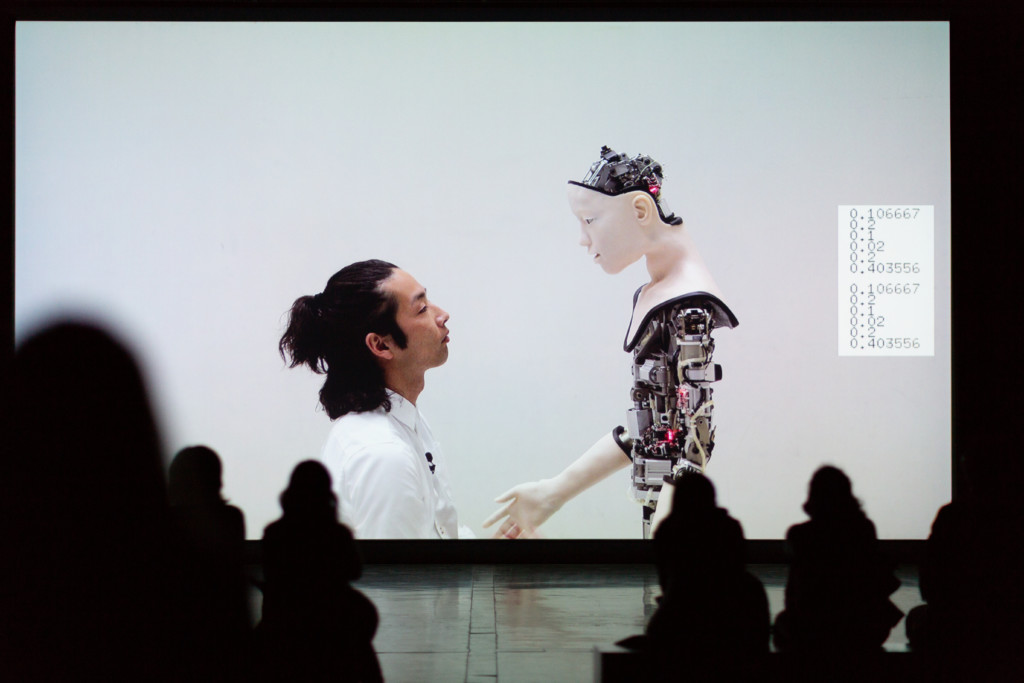
Co(AI)existence - JUSTINE EMARD - © Adagp photo by Mike Patten
FT: Precisely, how can we reconcile nature and AI, which are often seen as opposing forces?
JE: For me, opposing artificial intelligence and nature makes no sense, because everything, including what humans build, is part of nature. Generative algorithms allow us to observe the world differently, by processing data that humans couldn't analyze, thus pushing back the boundaries of our understanding. For example, in my installation Supraorganism, inspired by the organization of bees, I used data collected in a beehive to train an AI capable of recognizing and analyzing their behavior. This information animated a light installation, giving the impression of a living organism. It's this blend of biomimicry and machine learning, reactive to human presence, that creates a work where nature and technology converge.
FT: How do you perceive your place in contemporary art in the face of the return of figurative art?
JE: My work consists of making intangible elements visible, particularly through signals, which I consider a raw material for creation. I transform these signals into artworks, as in my neurofeedback installations where the viewer's brain interacts directly with the piece. For example, I created sculptures from brain recordings of astronauts' dreams, a fascinating way to materialize intangible data from space. This approach also raises questions: when we work with computational tools, such as machine learning, are we inventing or discovering? For me, these creations are no less true than reality; they offer another form of truth, a new vision of the world. By collaborating with fields like neuroscience and the CNES (French National Centre for Space Studies), I find it exciting that science and art can intersect to produce works that become the fruit of shared research.
FT: Do you think the interest in you is due to your position at the crossroads of disciplines, such as cognitive science, which is currently generating a lot of enthusiasm, and to your ability to make this complex knowledge more accessible?
JE: Since 2010, I've been interested in simulating reality, through augmented reality installations and video games, at a time when digital technology wasn't yet well-received in the art world, especially in France. My work doesn't aim to illustrate scientific theories or use technology without respecting fundamental research. I'm grounded in an approach that deeply understands research while remaining connected to reality, far removed from dystopian science fiction narratives. From my first projects with robots in 2016, despite the still-limited technologies, my goal was to reflect contemporary issues. I believe this approach, where art engages with science without fantasy or excessive fascination, partly explains the interest in my work.
3 works by Justine Emard
1/ Supraorganism
"The essence of this installation lies in the presence of a perceptible organism, creating its own space-time where a form of life seems to communicate, move and evolve. It translates the movement of life, sometimes programmed to provide a framework, but also leaving room for the unexpected, which makes the experience surprising. The installation, although abstract, is based on machine learning work inspired by a swarm of bees, while opening up a space to the imagination of the spectators. Blown glass, used for its optical and sound qualities, plays a central role, projecting animated reflections and vibrating under the effect of the strikers, thus giving new life to this material frozen by programming. This installation adapts and dialogues with the places where it is exhibited, transforming the space through light and sound. Some examples: at the Abbaye aux Dames in Caen, its reflections illuminated the white stone, while in a former coal factory, it mingled with darkness and machines. In a museum in Brussels, it evoked an aquatic space, and in a deconsecrated church in Italy, it was even perceived as mystical, embodying a divine dimension according to some spectators. Each place creates a new staging through architecture, materials, and acoustics, adding unique meanings. The work also took the form of a sound concert in collaboration with a composer, exploring yet other dimensions. By evolving and adapting in this way, it almost becomes a living entity that sometimes escapes me.
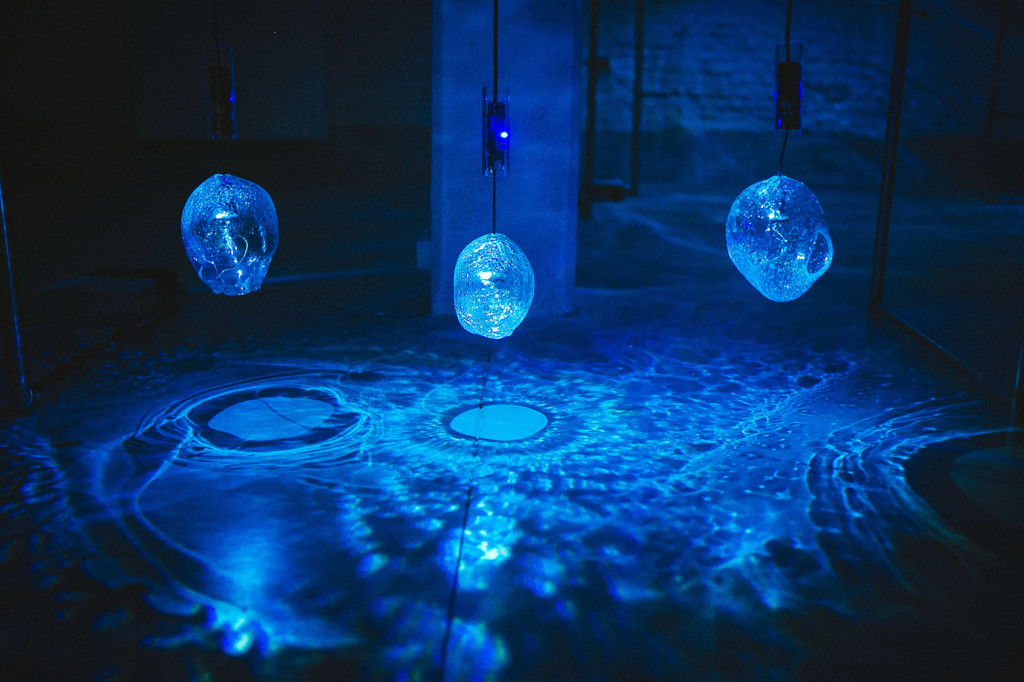
Supraorganism Justine Emard © Adagp, Paris 2021 - photo by Caroline Lessire
2/ Hyperphantasia
“This work explores the origin and representation of mental images, drawing inspiration from “aphantasia,” a rare neurological deficit that causes an inability to mentally visualize. Hyperphantasia suggests the opposite: the representation of highly realistic mental images. The work connects two origins of the image: humanity’s earliest parietal representations, such as those in the Chauvet Cave, and the pixels generated by modern technologies. Using machine learning models trained on images from the Chauvet Cave, dated 38 years ago, the installation creates a dynamic video fresco that reimagines these early traces. This work integrates the vibrations of the paintings animated by the light of prehistoric torches, almost evoking a primitive cinema, as well as sound elements theoretically present at the time. The installation juxtaposes the randomness of machine-generated images with human perception, where phenomena such as pareidolia transform signals into recognizable forms. It thus recomposes the universe of the cave, connecting the first technologies of visual representation to those of today in a visual and sensory narration. Another source of images is added. It comes from the human brain, it is the 000D printing of 3 dreams of astronauts identified during their stay in the international space station. Hyperphantasia traces a double spatio-temporal line, connecting the depths of the caves to the space station, and prehistory to the contemporary era. The links between caves and space are at the heart of the work: caves, like space, are complex environments where time, light, and landmarks are transformed, and where exploration and technology intersect. A strong analogy between cave and brain also structures the installation, enriched by a sound composition based on recordings of human neuronal crackles, recreating an atmosphere where images and sounds merge to represent a unique mental landscape.
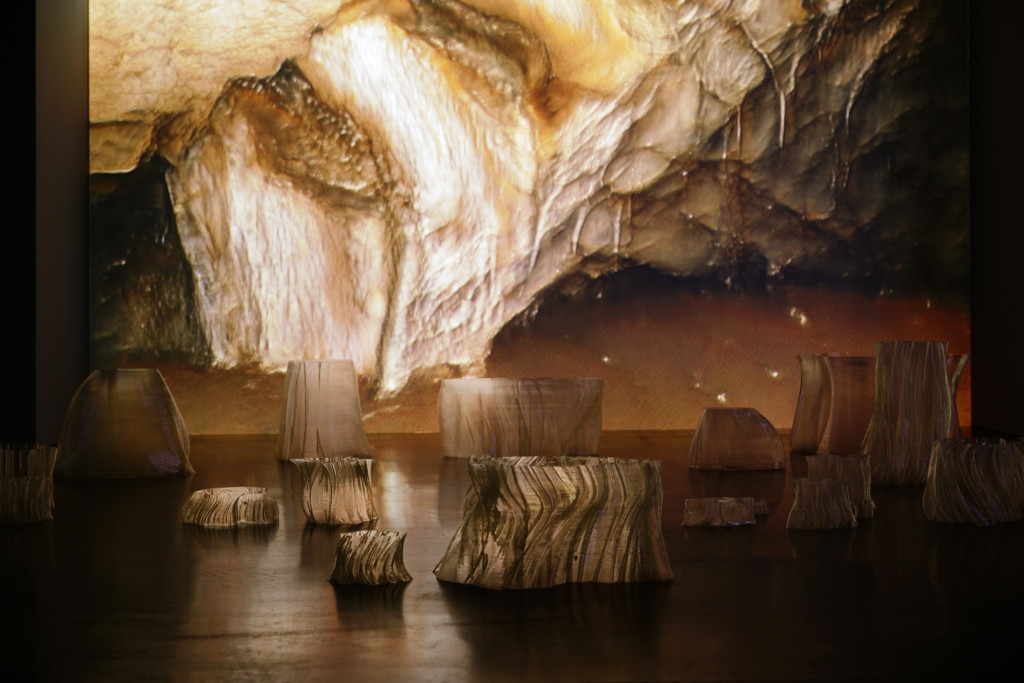
Hyperphantasia - The origins of the image © Justine Emard _ Le fresnoy _ adagp paris 2022
3/ Chim(AI)ra
“This third work is an installation combining video games and sculptures, created as part of my position as a visiting professor-artist at Le Fresnoy. The work is structured around 12 chimeras, avatars generated from 3D models found online, exploring the idea of a digital collective memory. These chimeras evolve in an interactive digital ecosystem where the activity of the computer's graphics card directly influences the atmosphere of the game. The player embodies the chimeras in an initially red and unbreathable world, where the computer heats up under the load. The goal of the game is to gradually simplify the visual layers, moving from detailed textures to black and white images, until the graphics card is completely lightened and the ecosystem cools down, making the world of the chimeras more habitable. The project also includes 3D sculptures representing the chimeras, petrified in a natural spring. This process symbolizes an interaction between digital and nature, where nature reclaims its rights over these imaginary creatures. With a playful and humorous approach, Chim(AI)ra » questions the links between technology, ecology and collective memory. »
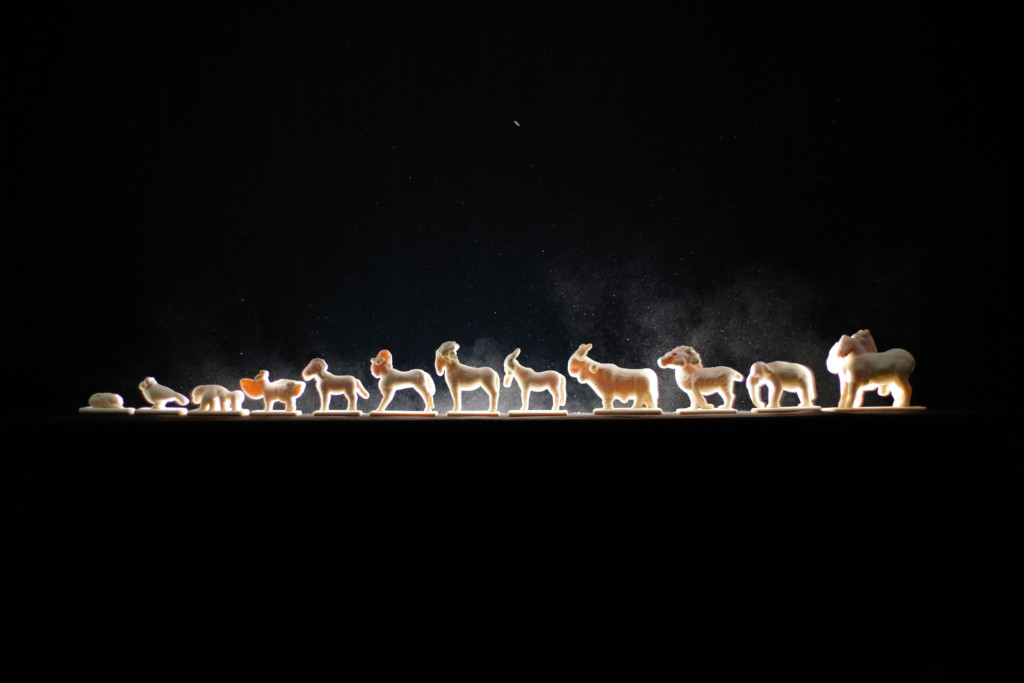
Chim[AI]ra © Justine Emard - Le Fresnoy _1014728
Related articles
- All
- Visual arts & Art de vivre
- BIG
- Film & Audiovisual
- Creator Economy
- Cultur'Export
- Edition
- Video games
- Fashion & Design
- Music & Performing Arts
- Headquarter
- Mixed realities and immersive technologies
- South by southwest
- We Are French Touch